A light sample of an analyst-grade report
Same earnings headline.
Completely different meeting.
A specialty chemicals company posts a drop in sales. The trade press runs it. Anyone reading the headline walks into that meeting and talks about saving money.
Here is what the room actually looks like.
What follows is a light sample. The full report runs to analyst length, covers everyone expected in the room, and is built against the specific thing you sell. A handful of findings are shown here, on a company that does not exist.
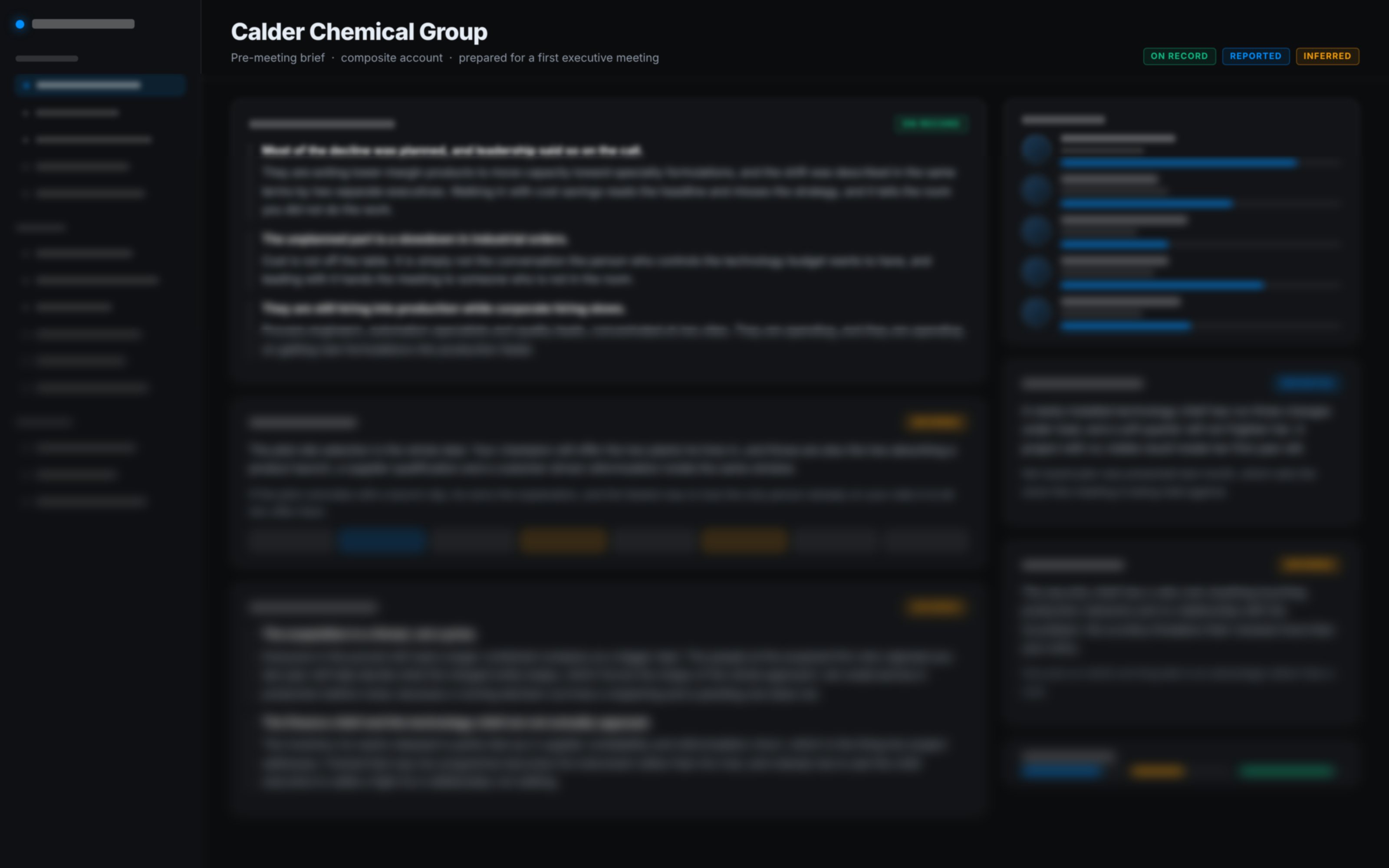
Every line in a brief carries where it came from, because a seller needs to know which sentences they can say out loud and which are a question to ask.
What the headline is hiding
Most of the decline was planned, and leadership said so on the call.
ON RECORDThey are exiting lower-margin products to move capacity toward specialty formulations. Walking in with cost savings reads the headline and misses the strategy, and it tells the room you did not do the work.
The unplanned part is a slowdown in industrial orders, and that is what the board is uneasy about.
REPORTEDSo cost is not off the table. It is just not the conversation the person who controls the technology budget wants to have.
They are still hiring process engineers, automation specialists and quality leads while corporate hiring slows.
ON RECORDThey are spending. They are spending on getting new formulations into production faster. That is the sentence to build the meeting around.
Who is actually in the room
The new technology chief has run three changes under load: a plant consolidation mid-production, a batch-tracking rebuild after a recall, and a systems integration through an acquisition.
REPORTEDA soft quarter will not scare her. A project with no visible result inside her first year will. Her board plan was presented last month, so her clock is running.
Your champion's exposure changed when his reporting line did.
INFERREDHe now reports to her and owns a product launch at the two plants a pilot would run in. His support is real and it is no longer free. Ask him to carry risk he cannot afford and he goes quiet rather than refusing. Worth testing directly rather than assuming.
The security chief is the cheapest ally in the building, not the gate everyone treats him as.
INFERREDHe has a veto over anything touching production networks and no relationship with the incumbent. His scrutiny threatens their renewal more than your entry, because they are already connected to the plant floor. This is the one axis where arriving late is an advantage.
Where the threads collide
Each fact above sits in a different part of the brief. None of them is the finding. The finding is what happens where they meet.
The pilot plant selection is the whole deal.
INFERREDYour champion will offer the two plants he lives in. Those are also the two absorbing a product launch, a supplier qualification and a customer-driven reformulation, and one has a labour negotiation coming. If the pilot coincides with a launch slip, he owns the explanation. Letting him offer those plants is the fastest way to lose the only person already on your side.
The acquisition is a threat, not a prize.
INFERREDEveryone will read a larger combined company as a bigger deal. The people at the acquired firm who rejected you last year will help decide what the merged entity keeps. Which forces the shape of the whole pursuit: win small and be in production before close, because a running decision survives a reopening and a pending one does not.
The CFO and the technology chief are not actually opposed, and nobody has noticed.
INFERREDThe inventory he wants to release is partly tied up in supplier unreliability and reformulation churn, which is what production flexibility addresses. Framed that way her project becomes his instrument rather than his rival, and nobody has to ask the CEO to settle a fight he is deliberately not settling.
The industry analyst take
One read of the whole account, in the order it would be delivered.
The question behind the meeting
1 / 5
Calder is not deciding whether to buy software.
It is deciding how much operational risk it can absorb in the three quarters before the acquisition closes.
Read that way, the soft quarter stops being the subject of the meeting and becomes the reason the meeting is tense. Nobody in the room will say this out loud, because saying it concedes that the acquisition is driving the calendar rather than the strategy.
Three units of measure
2 / 5
Everyone is answering that question in a different currency.
Which is why the room will seem to agree and then not move.
The move
3 / 5
One deployment satisfies all three at once, and only one.
A narrow deployment at a site with nothing else happening to it, running in production before the deal closes.
It gives the technology chief a result inside her first year. It keeps your champion away from the plants where a slip would be his to explain. It touches the working capital question rather than competing with it, because the inventory he wants released is partly tied up in the churn this addresses.
That is the pursuit. Everything else in the brief is in service of getting to that sentence.
What it forces
4 / 5
Four decisions follow, and they do not trade against each other.
Where this take could be wrong
5 / 5
Two things would change it, and one claim is thinner than the rest.
If the acquisition slips past their fiscal year, the clock argument weakens and the case for a larger first deployment gets stronger, not weaker.
If your champion's reporting line reverts, his exposure resets and he becomes the right person to pick the site rather than the wrong one.
And the security chief reading rests on the absence of a relationship with the incumbent rather than on evidence of one. It is the weakest claim here, it is marked inferred for that reason, and it is worth ten minutes of checking before anyone builds a sequence on it.
What not to say
A brief that only tells you what to do is half a brief. One of their board members sits on the board of a major customer of your competitor. Nobody has said anything. Nobody has to.
That is a fact to hold, not to use. Naming it in the room costs more than it gains and makes everyone defensive. It appears in the brief flagged exactly that way.
What this page is, and what it is not
Calder, the company it acquires, and every person in it are invented. The scenario is assembled from patterns across many deals rather than taken from any one account, and no customer's brief appears here.
This is also a light sample, not a brief. A real one runs to analyst length, covers every person expected in the room rather than three, and is built against the specific thing you sell, which changes what matters. The analytical structure behind it is not shown here and will not be. The image above is rendered from this same invented account with the section names withheld, for the same reason.
What it is meant to show is the standard. Whether the reasoning is worth having, and whether the line between what is on the record and what is a hypothesis is drawn where it should be. If it is not, the rest of the claims on this site are worth nothing either.
The reasoning behind why a meeting works this way is set out in The DNA of the Meeting.
Bring an account you already understand.
That is the only test that counts. You will know inside a minute whether what comes back tells you something you did not know, or tells you things you did know in a neater format.
Request beta access