MEDDPICC vs MEDDIC: Which Sales Qualification Framework Is Right for Your Team?
MEDDIC has been a standard qualification framework in enterprise sales for over two decades. MEDDPICC is its more comprehensive successor, adding two additional dimensions that matter enormously in complex, multi-stakeholder deals. Understanding the difference - and knowing when to use each - is one of the more practical decisions a sales leader can make.
What MEDDIC Covers
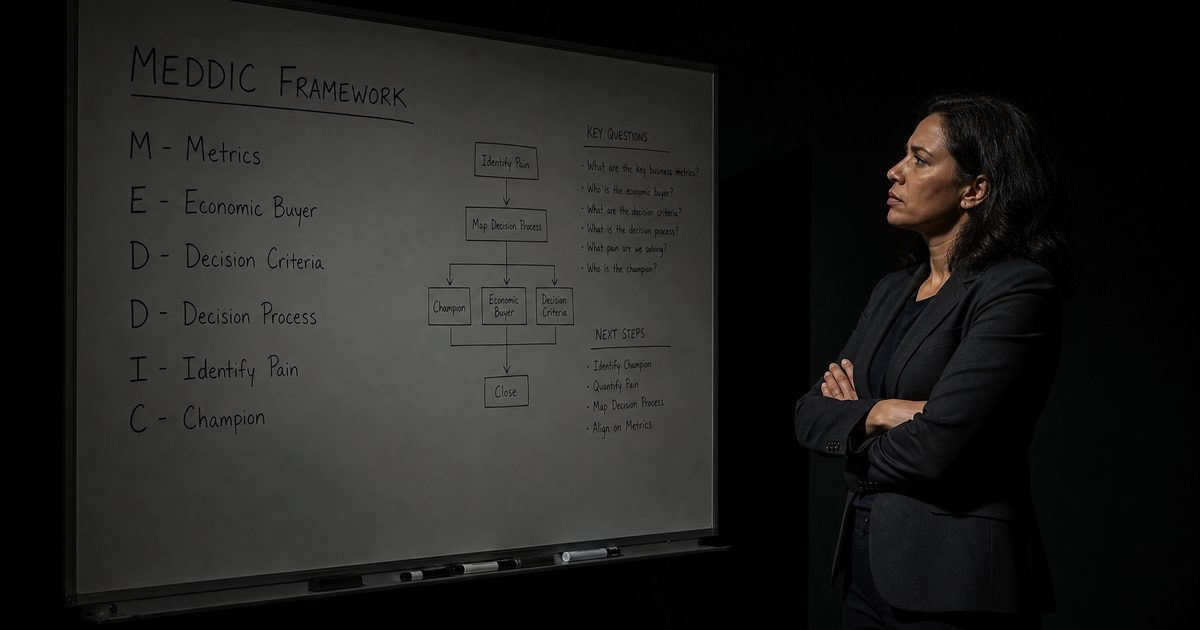
MEDDIC is an acronym for six qualification criteria:
| Letter | Criterion | What It Means |
|---|---|---|
| M | Metrics | The quantifiable business impact your solution delivers |
| E | Economic Buyer | The person with budget authority and final sign-off |
| D | Decision Criteria | The formal and informal criteria the buyer uses to evaluate options |
| D | Decision Process | The steps, stakeholders, and timeline involved in making the decision |
| I | Identify Pain | The specific business problem driving urgency to act |
| C | Champion | An internal advocate who sells on your behalf when you are not in the room |
MEDDIC was developed at PTC in the 1990s and became widely adopted because it forces sales teams to qualify rigorously rather than chase deals on optimism. A deal that cannot answer all six criteria is not qualified - it is a wish.
What MEDDPICC Adds
MEDDPICC adds two letters: P for Paper Process and an additional C for Competition.
| Addition | Criterion | What It Means |
|---|---|---|
| P | Paper Process | The legal, procurement, and contracting steps required to close |
| C | Competition | Who else is being evaluated and how you are positioned against them |
These additions address two of the most common reasons deals stall or die in the final stages of an enterprise sales cycle.
Why Paper Process Matters
In enterprise sales, a deal can be fully qualified, championed, and approved by the economic buyer - and still take four months to close because of procurement, legal review, security assessments, and contract negotiations. MEDDPICC forces you to map this process early, so you are not surprised when a "verbal yes" turns into a six-month legal review.
Understanding the paper process means knowing: Who initiates the purchase order? Does legal need to review the contract? Is there a security or compliance review? Are there standard vendor approval processes? What is the typical timeline from verbal approval to signed contract?
Why Competitive Intelligence Matters
MEDDIC assumes you understand the competitive landscape, but does not build it into the framework explicitly. MEDDPICC makes it a required qualification criterion. You should know: Who else is being evaluated? What are the buyer's perceptions of each option? Where do you win and where do you lose against each competitor? Does your champion understand your differentiation well enough to represent it internally?
When to Use MEDDIC
MEDDIC is appropriate for:
- Shorter sales cycles where procurement complexity is low
- Mid-market deals with fewer stakeholders and a simpler decision process
- Teams new to structured qualification who need a framework that is easier to adopt and coach
- Early-stage companies where the competitive landscape is still being defined
MEDDIC is a strong foundation. The risk is that it does not force you to think about what happens after the economic buyer says yes, or how you are positioned against the alternatives the buyer is considering.
When to Use MEDDPICC
MEDDPICC is appropriate for:
- Enterprise deals with long sales cycles where paper process delays are common
- Deals with multiple competing vendors where competitive positioning is a live variable
- Large ACV opportunities where the cost of a late-stage loss is high enough to justify deeper qualification
- Mature sales teams who have already internalized MEDDIC and need more rigour
If your average deal involves procurement, legal review, and a competitive bake-off, MEDDPICC is the more complete framework.
The Practical Difference in CRM Usage
In practice, the difference between MEDDIC and MEDDPICC shows up most clearly in how you qualify deals in your CRM and in deal reviews.
With MEDDIC, a deal review asks: Do we have metrics? Do we know the economic buyer? Do we understand the decision criteria and process? Have we identified the pain? Do we have a champion?
With MEDDPICC, you add: Do we understand the paper process and timeline? Do we know who we are competing against and how we are positioned?
The two additional questions in MEDDPICC are often where deals die. Adding them to your qualification standard forces the conversation earlier.
Common Mistakes with Both Frameworks
Treating them as a checklist rather than a conversation. MEDDIC and MEDDPICC are qualification frameworks, not forms to fill out. The value is in the questions they prompt, not in checking boxes.
Confusing the economic buyer with the champion. These are often different people. The economic buyer has budget authority. The champion has influence and advocates for you. A deal with a strong champion but no access to the economic buyer is not qualified.
Assuming the decision process is what you were told. Decision processes in large organisations are rarely as clean as the buyer describes. Map the informal process - who has veto power, who influences the economic buyer, what has killed similar decisions in the past.
Ignoring the paper process until it is too late. The most common version of this mistake is forecasting a deal to close in Q3 without knowing that the company's legal review takes 90 days.
Which Framework Does ControlTheRoom Use?
ControlTheRoom's Sales Meeting Prep tool incorporates MEDDPICC as part of its deal health analysis, surfacing qualification gaps, champion strength, competitive positioning, and paper process signals as part of every pre-meeting brief. Rather than manually updating your CRM with MEDDPICC fields, the brief surfaces what you know, what you do not know, and what you need to find out in the next meeting.